Sharing the cost? How termite colony fusion affects soldier production and fitness

Colony fusion – an inclusive fitness conundrum
In the forests of California, the termites are doing something strange.
In termite colonies, most individuals entirely give up on their own reproduction entirely to help their colony-mates to reproduce instead. But this is not the strange thing, inclusive fitness gives us a good understanding of why this should happen: when individuals are closely related, it can be beneficial for one to help the other provided that the individual who received the help goes on to reproduce more as a result. This phenomenon is put most succinctly in Hamilton’s rule, which says that the cost of providing help must be less than the benefit of that help multiplied by relatedness (in maths: c < rB) in order for helping behaviour to evolve. This rule has come to exemplify a fundamental tenet of social evolution, that relatedness is fundamental for the evolution of altruism.
This rule is apparently exemplified in the social insects, which live in large family groups of closely related individuals most of whom help to raise their siblings rather than having their own offspring (maybe the ultimate act of altruism). So it was somewhat surprising when researchers looked at the genetics of termite colonies and found that many of them contained individuals that were not closely related. In fact, some colonies were made up of two distinct groups, behaving as if they were one and the same colony. Perhaps this could be put down to a mis-step, maybe this is just a rare event and therefore there is no selection against it? Except that in some species, more than 25% of colonies appear to be made up of two previously separate, unrelated colonies (Korb & Roux 2012). Given what we know about relatedness and altruism, this behaviour seems strange, so how does it come about?

Previous work shows that in the colonies that fuse, some workers change their developmental trajectory. Rather than staying as workers for their whole lives, they can become reproductive after fusion. This means that fusion might be a result of some individuals within a colony acting in their own self-interest so that they themselves can become reproductive. Even though this is costly to the other individuals in the colony, this inheritance of reproductive rights for these few workers is currently the most likely explanation for how fusion events come about. But what about the others? What about the non-reproductive workers that continue to develop following a fusion event? This is what we wanted to dig into. Specifically, we wanted to understand: how can colonies can continue to produce non-reproductive workers despite the much lower relatedness of the fused group?
Our model and predictions
We started to answer this question by modelling the investment that two colonies might make in soldiers – a non-breeding type of termite whose role is to protect the colony – before and after one of these fusion events as a ‘collective investment game’(Madgwick et al. 2018). This type of model looks at what happens when two players (in this case, two colonies) can both invest in a common good (in this case, soldiers), which is costly to produce but beneficial to both players. By modelling termite fusion events in this way we show that, while it is usually best for colonies to reduce their investment in soldiers because of the decreased relatedness in fused groups, it can be better for individuals to continue investing in soldiers even after they fuse with another colony if the fusion event causes the cost of soldiers to fall or the benefit to increase; the extent to which a colony should adjust its soldier investment after fusion depends on its relative size, which affects how much average relatedness falls (shown in the schematic below).
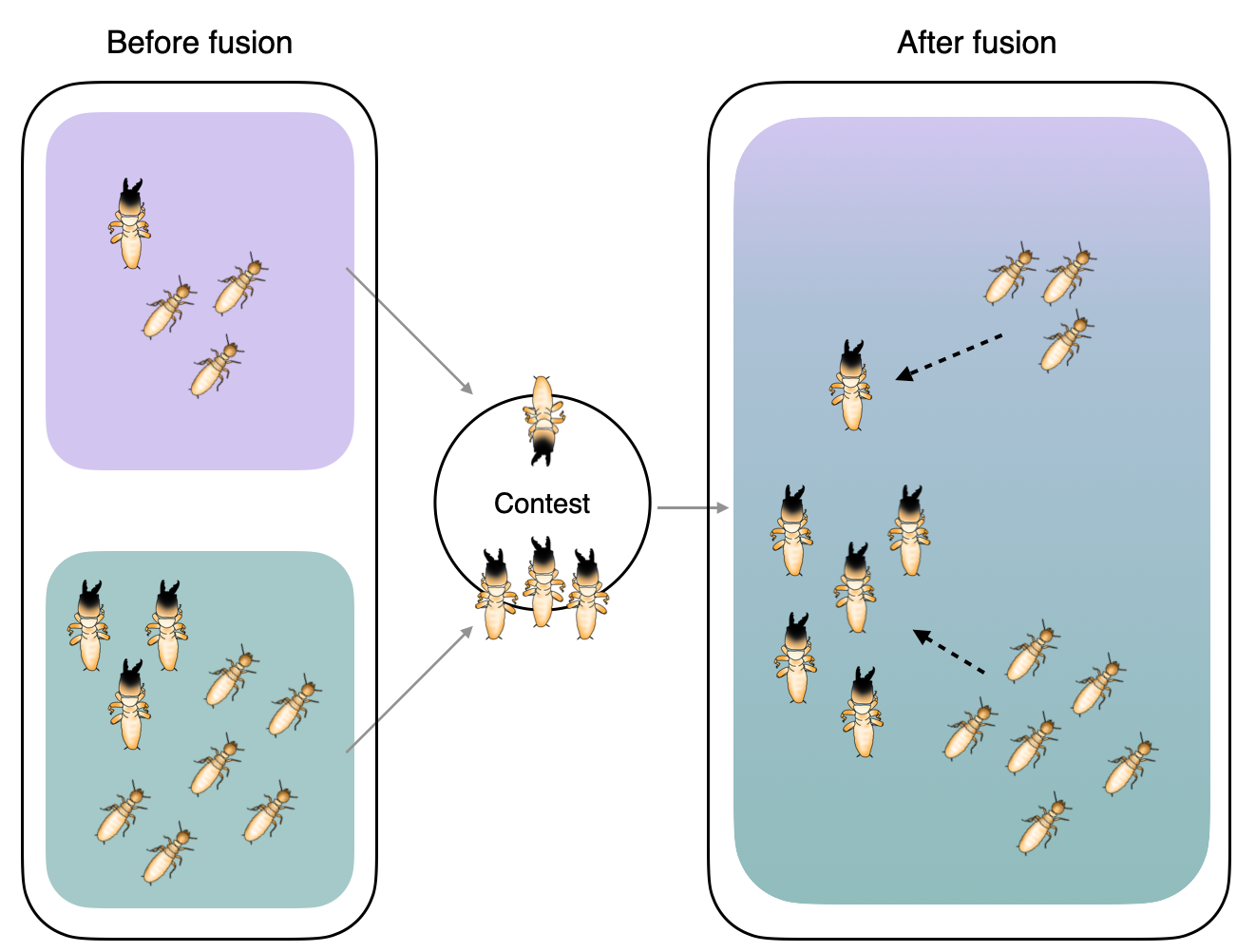
The cost of soldiers could fall if a colony is able to gain access to more resources because of the fusion. This is likely to be particularly relevant to colonies of single-piece nesting termites. In these termite species, when a queen and king found a new colony, they make their home in a piece of dead wood. This single piece of wood is the home of the colony for the colony’s entire lifespan. This means that this one piece of wood provides all of the resources that a colony has access to. But it is not uncommon for multiple colonies to be founded in the same piece of wood. If this happens, a colony can only access its own part of the resource, and not whatever part of the wood the other colony is living in. But, if these two colonies fuse, then the fused colony now has access to the whole resource. On the other hand, nomadic or foraging termites are not constrained in their resource acquisition in the same way so this mechanism of reduced soldier cost is less likely to apply to them. Our model therefore predicts that single-piece nesting termites might maintain or increase their soldier production after fusion as a result of greater resource access, but this is likely to be less important for non-single-piece nesters.
As well as the cost of soldier production decreasing, the benefit from soldiers might increase. This could happen if larger colonies are more vulnerable to predators. A larger termite colony could be more vulnerable to predation if they are more conspicuous in their environment. It is likely that larger colonies are more conspicuous because they are likely to be louder and create stronger vibrations in the substrate that they are in, as well as being visually more obvious because they take up more space. The model therefore predicts that if larger colonies are at greater risk of predation than smaller colonies, then it could be beneficial for the colonies in a fused group to produce more soldiers than they did previously to protect their future reproductives. The effect of both cost reduction and benefit increase is likely to be more relevant for the colony that makes up the majority of the fused group; this group’s relatedness falls less so they are predicted to invest more than a minority colony.
Our model also showed that a colony in a fused group could gain fitness benefits (i.e., produce more reproductives) after a fusion event. It is possible for a colony to gain fitness following fusion if it is able to exploit the investment in soldiers that the other colony makes. There is evidence consistent with this prediction because in some termite species, individuals show less aggression towards colonies in which there is a higher proportion of workers compared to nymphs (a pre-reproductive caste; Matsuura & Nishida 2001). Alternatively, if the costs of solider production fall or the benefits increase (as they might do given resource constraints and predator attraction to larger groups), this can also provide fitness benefits to colonies in fused groups. The model predicts that smaller groups are more likely to gain fitness following fusion because of the larger investment by the majority colony.
What next?
Our model provides predictions that can be tested in termites in two main ways: 1) by running experiments to see if soldier production can be manipulated as our model predicts; and 2) by comparative analysis of termites with differing ecologies. By experimentally constraining or providing extra resources in the lab, for example, it could be possible to test whether termite colonies do really respond to differences in resource availability as a result of fusion. And experimental tests in the field could reveal the relative resource constraints of single-piece compared to nomadic or foraging termites, as well as the extent to which larger colonies are more vulnerable to predation. It would be interesting to see a systematic comparative analysis of colony fusion across termite taxa to identify how termites with different life histories and ecologies respond to neighbouring colonies, and whether this matches the predictions of our model.
More broadly, our model shows how the counter-intuitive production of an altruistic type of termite in groups with low relatedness might come about, but, as always, more work is needed to really understand how this works in the real world.
Read our open access paper in Insectes Sociaux.